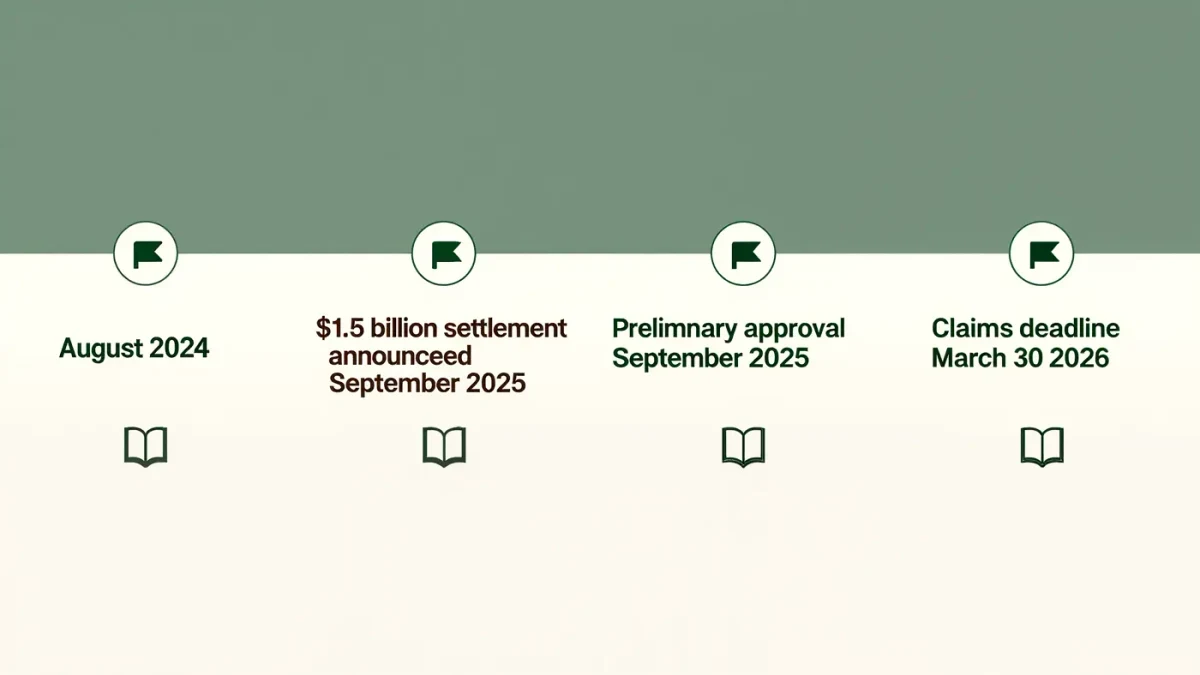
The $1.5 billion settlement resolving Bartz v. Anthropic, granted preliminary approval by the court in September 2025, has opened a claims window that closes March 30, 2026 — per the Authors Guild's published guide and the class administrator's site. The case, filed in August 2024 by authors Andrea Bartz, Kirk Wallace Johnson, and Charles Graeber, alleged that Anthropic used pirated books to train its language models, and the award is split among rightsholders of the books in the settlement class. For working writers the practical step is administrative: if your books are covered, the claim form is online, and the deadline is the date to circle.
The settlement is the loudest signal yet that AI training data has a price. Per Reuters' coverage of the deal, it ranks among the largest copyright settlements in the AI era, and it arrived while trade publishers were still negotiating what licensing books for training should look like. Bloomsbury confirmed to the Society of Authors in August 2025 that it was exploring an AI licensing arrangement, prompting the Society to demand consent and payment terms for authors whose books would be included. Industry analysis — Jane Friedman's among the most read — keeps landing on the same caution: the value of these deals for authors remains unclear until splits and opt-outs are contractual.
What changes at the contract table in 2026: AI clauses. The new boilerplate arriving from publishers addresses whether books can be licensed for training, on what split, and whether authors can opt out — and agent guidance published since the settlement treats these clauses as negotiable, not standard. Writers negotiating this year should read any "artificial intelligence" or "machine learning" section as carefully as the royalty schedule, ask who holds consent rights, and get the answers in writing before signature.
Two background facts make the moment easier to read. Registration still matters: timely U.S. copyright registration underpins statutory remedies in exactly these cases, and the Copyright Office's AI materials track the legal state of play. And the claims window rewards paperwork — rightsholders who cannot document their titles simply join the majority of unclaimed funds. Daily Pencil publishes information, not legal advice; for claim eligibility, consult the administrator's site and, where the money justifies it, counsel.