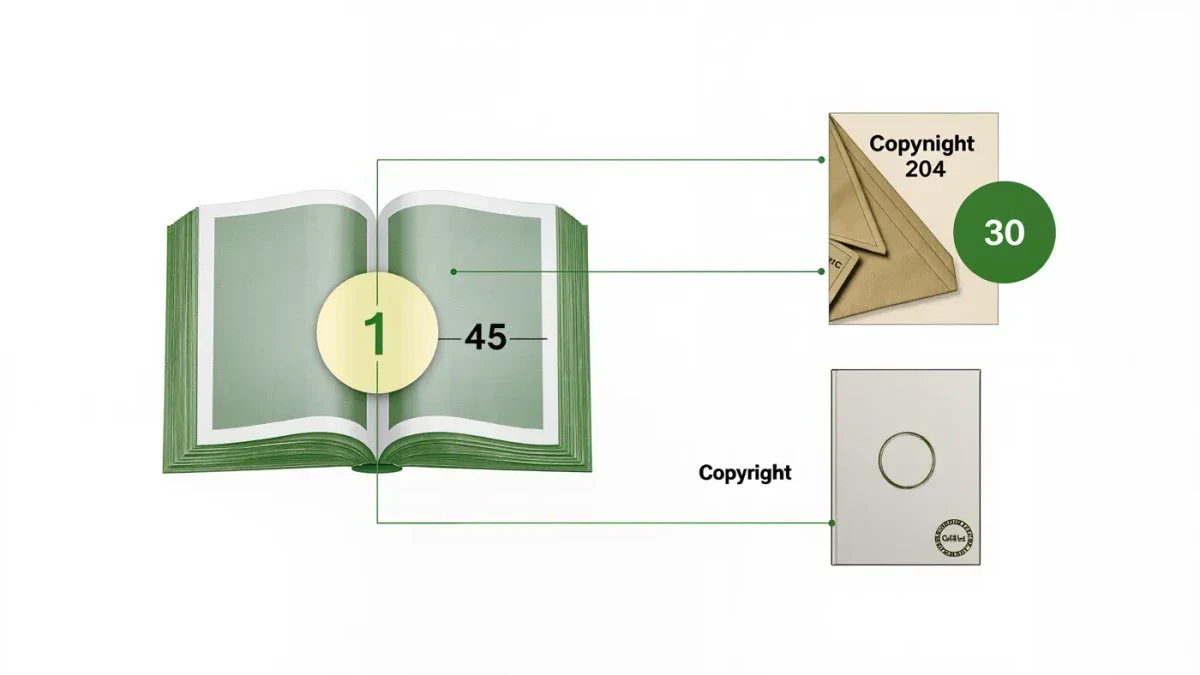
The collector's first discipline is identification, and the trade's standard shorthand is mechanical: most modern first printings carry a number line on the copyright page — a row like 1 3 5 7 9 10 8 6 4 2 — in which the presence of the 1 marks the first printing, and its absence marks a later one. Combine that with the stated printing history, the dust jacket's unclipped price, and the publisher's first-edition statements, and the beginner can authenticate most post-1970s books without expertise. Older books run on points of issue — the specific errors and variants documented in bibliographies that distinguish a true first from the corrected second — a culture the trade has maintained since the nineteenth century.
What makes a first edition worth anything?
The same scarcity-plus-story logic that prices manuscripts: significance of the book, smallness of the first printing, condition, and completeness — and for the modern era, completeness mostly means the dust jacket, which is where value concentrates on post-1920s books. A jacket in fine condition can carry the majority of a book's price, because jackets were designed to be thrown away; survival is the rarity. Book club editions are the classic trap: visually near-identical shelf copies distinguishable by the missing price on the jacket's flap and a small blind stamp punched into the rear board — two minutes of checking that separate a fifteen-dollar book from a fifteen-hundred-dollar one.
How does condition grading work?
On the trade's standardized scale, descending: Fine (as new, no defects); Near Fine (approaching fine with minor flaws); Very Good (shows use but sound); Good (complete and intact, honestly worn); Fair and Poor (reading copies, generally valueless as collectibles). The conventions — published across dealer associations' glossaries and used consistently in ABAA and ILAB catalogs — grade book and jacket separately ("Fine in a near fine jacket"), and the honest grade is the one that describes the flaw a buyer will find. New collectors should grade their own books one notch below their hope; the discipline costs nothing and builds the reputation that gets you the good material later.
Where do beginners buy safely?
In order of safety: established dealers who are members of the antiquarian trade associations — the ABAA in America, ILAB internationally — whose catalogs state condition and issue points and whose reputations enforce honesty; book fairs, where the same dealers stand behind tables you can argue at; auctions for material you can inspect or trust the house to describe; and online marketplaces last, where the buyer without the authentication toolkit is the target demographic. The documented beginner sequence: buy from dealers until you can grade, buy at fairs until you can negotiate, and only then buy online — where the game's best bargains and worst fakes share a photograph.
How should a collection be built?
Around an idea rather than around a price level — the advice dealer memoirs repeat. The single-book-at-a-time collector chases the same famous trophies everyone chases and pays trophy prices; the thematic collector (one imprint's noir list, the novels of one neglected decade, every book an admired press printed) buys where competition is thin and knowledge compounds. The collection with an argument also outperforms at dispersal — libraries and dealers pay for coherence, and the documented auction premiums for single-owner libraries are premiums for the collector's eye. Set a budget per year rather than per book, keep the spreadsheet from the first purchase (author, title, printer's points, grade, provenance, price), and accept the trade's quiet consensus that the money is better spent on depth in one lane than surface in ten.
How do you care for what you collect?
Cheaply and non-negotiably: upright on the shelf, supported, out of sunlight, away from the damp basement and the dry radiator — both ends of the humidity spectrum destroy paper and cloth. Mylar jacket protectors, the trade standard, cost little and preserve the value-carrying object. Repairs are for professionals; the documented disaster class is the well-meant home repair — tape on a jacket, glue on a spine — that converts a fine copy into a conversation piece. Handle the book by its spine-free middle when open, and the collection will outlast the collector in the condition that pays for its own keeping.
Frequently asked questions
Are first editions always the most valuable printing?
Almost always for significant books — with documented exceptions where a later printing carries famous corrections or illustrations collectors prize. The rule of thumb holds: the first printing of the first edition is the default object of desire; exceptions are exactly that.
Do signed copies matter?
Signatures add value in proportion to scarcity and provenance — a flat-signed first printing of a landmark book is a different object from a bookplate-signed later printing. Forgeries exist at the top of the market; buy significant autographs through channels that guarantee authentication.
Can collecting be an investment?
Occasionally, accidentally. The trade's honest guidance treats appreciation as a possible side effect of knowledge and patience, not a plan — the documented winners are collectors who bought what they understood and loved, and the documented losers are portfolios assembled for appreciation alone.