Most people stand in front of a painting for a few seconds, feel nothing, and move on. The problem is not taste or talent. It is method. Critics are not born seeing more; they have simply learned to ask a work a short series of questions, in order, before deciding how they feel about it.
This article gives you that series. It works on a painting, a photograph, a sculpture, or a mural on a brick wall. The only equipment it requires is time — critics often give a single work several minutes, not seconds — and the willingness to describe what you see before you decide what you think.
The word itself gives the method away. To read, in its oldest sense, is not merely to recognize words. The Free Dictionary traces the English verb back to the Old English rǣdan, which meant to advise and to interpret something difficult — and it notes that English is unusual among Western European languages in not deriving its word for reading from the Latin legere. Reading, in that older sense, is interpretation under uncertainty. That is exactly what you do with a work of art. You look carefully so as to understand its meaning, which is also how Dictionary.com defines the act: to look at carefully so as to grasp the significance of what is before you.
Why does gallery intimidation happen, and how do you get past it?
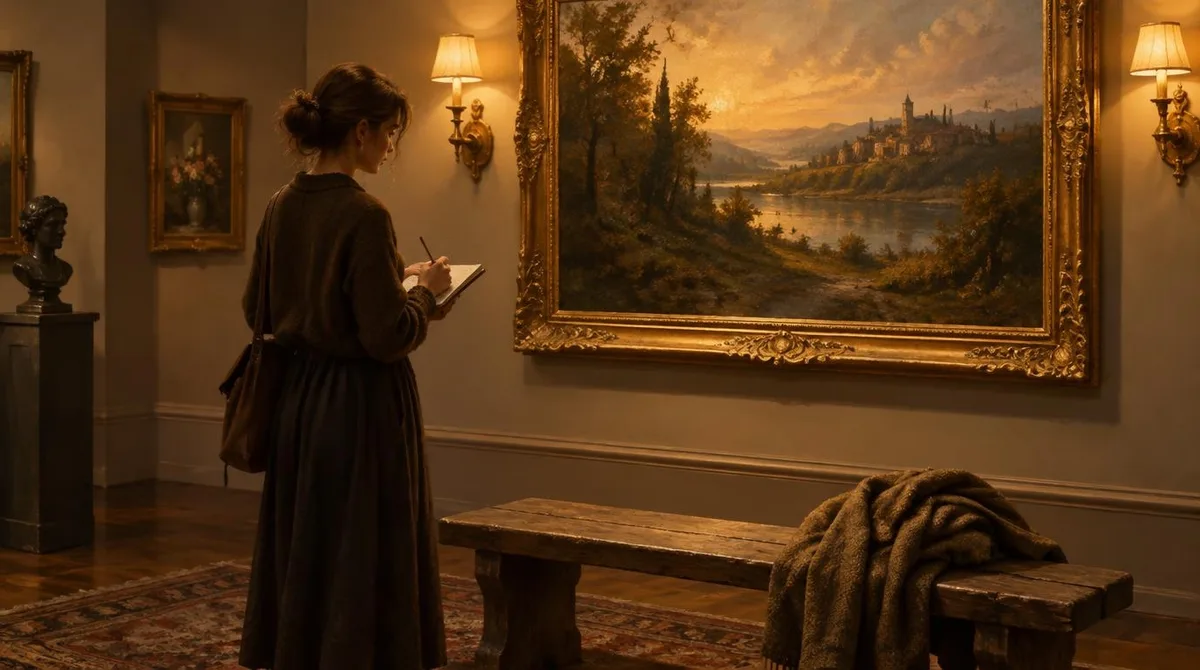
Intimidation comes from a false belief: that a correct interpretation already exists and everyone else knows it. In reality, a work of art supports many defensible readings, and the critic's job is to build one honestly from evidence. The cure is to slow down and start with what is physically there. Give one work a full five minutes. Most visitors give it ten seconds. The difference alone will put you ahead of the crowd.
It also helps to remember that confusion is a normal early stage, not a verdict on you. A work made by a trained hand, in a language of composition and material, takes a few minutes of attention before it starts to yield anything. Treat the first minutes as warm-up, not as a test you are failing.
What should you notice first: the five-step method
Here is the sequence, in order. Each step feeds the next, and skipping the early ones is why most readings collapse later.
- Inventory. List what is literally in the frame: objects, figures, colors, shapes, where light falls. No interpretation yet. Just naming.
- Composition. Where does your eye go first, and what path does it take? What is large, what is small, what is cut off at the edge? Artists arrange these things on purpose.
- Material and making. What is it made of, and can you see the hand in it — brushwork, chisel marks, the flatness of a print? Scale matters here too; a canvas the size of a wall does something a postcard cannot.
- Context. Read the wall label. When was it made, where, by whom? You do not need the label to look, but you need it to check your hunches against history.
- Reading. Only now ask what it all adds up to. What mood does the work build? What might it be about? State your reading in one sentence, out loud if you can.
What this means in practice: your one-sentence reading is now defensible, because you built it from things you can point to. Anyone can disagree with a feeling. It is much harder to disagree with an inventory, a compositional observation, and a date.
How do critics describe a work without sounding vague?
They trade feeling-words for seeing-words. "Haunting" tells nobody anything. "The figure is lit from below, so the shadows fall upward, and that makes an ordinary room feel wrong" tells a reader exactly what produced the mood. The habit to build is cause and effect: name the visual fact first, then the effect it creates, joined by "because" or "so."
Short, plain sentences do most of the work. Critics also describe what is absent — the empty chair, the missing face — because absence is often where a work does its real arguing. If you find yourself using only adjectives, go back to step one and inventory again.
Does the title and label change how you should look?
Look first, read the label second. If you read first, the label hands you an interpretation and you will spend your five minutes confirming it instead of testing it. After you have your own one-sentence reading, compare it with the title and any curatorial text. Agreement is satisfying; disagreement is often more interesting, because it raises a real question: did the artist intend something the institution frames differently, or is the work open on purpose? Either way, you now have something to think about rather than something to swallow.
What this means for your next gallery visit
Plan to look closely at three works, not quickly at thirty. Use the five steps on each. Write your one-sentence readings down; the act of writing forces precision, and comparing notes across visits is how taste actually develops. Over time you will notice patterns — kinds of composition you respond to, materials you distrust, periods you want to learn more about — and those patterns are the beginning of a critical eye.
The same method travels well beyond the museum wall. It works on a book jacket, where design carries the argument of a whole novel — our piece on Book Cover Design as Art follows a similar path from surface to meaning. It works on work made in public, where the question of what a piece is doing depends heavily on where it sits, as the debate over Street Art vs Vandalism shows. And once you can read a work, you can start to read its price, which is a different skill entirely — one we take up in How Auction Houses Set the Price of Art.
None of this guarantees you will like what you see. That was never the point. The point is that the work will have said something to you, and you will be able to say what it was and why — which is, in the old sense of the word, what reading has always meant.