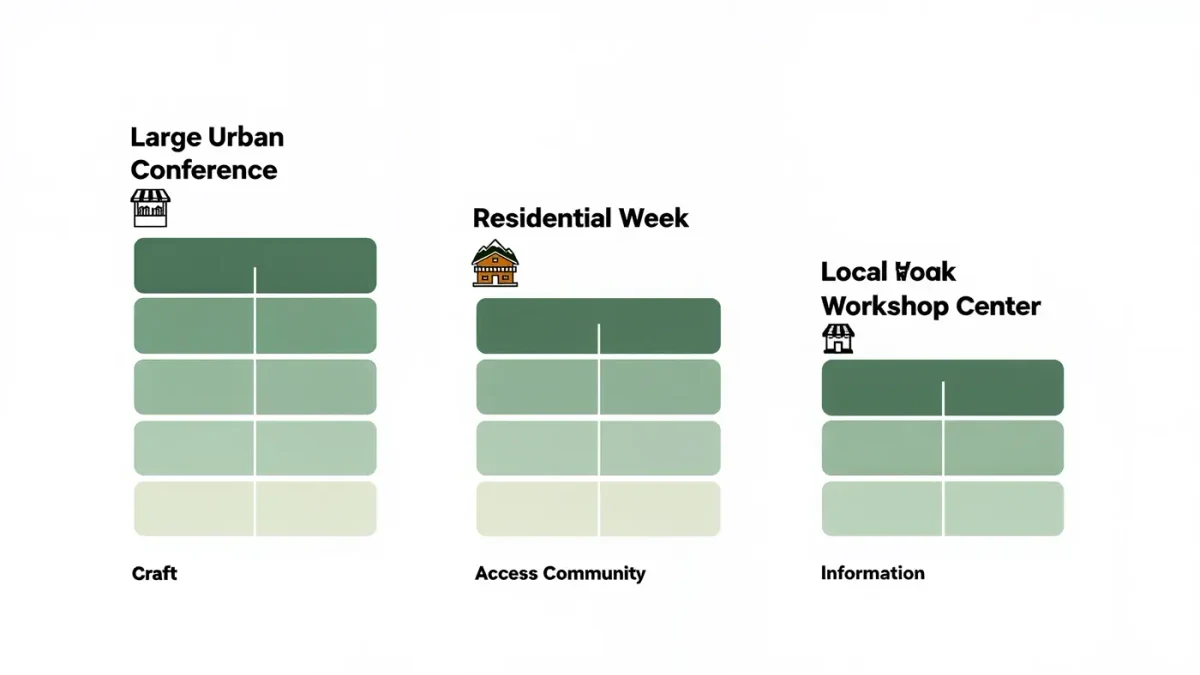
The American conference calendar has documented anchors: AWP — the Association of Writers and Writing Programs' annual conference — which draws many thousands of writers and hundreds of exhibitors to its bookfair; residential conferences like Bread Loaf and Sewanee, admission by application with a writers' conference lineage dating to the 1920s and '30s; and the urban workshop centers like GrubStreet and Tin House's programs, running on tuition rather than endowment. Registrations for the large urban conferences typically run in the low hundreds of dollars, residential weeks in the four figures — documented ranges, worth holding against what each format actually delivers, because the formats deliver different things.
This is a survey of standard conference practice, not an endorsement of any program.
What are the four things a ticket buys?
Craft, access, community, and information — in varying proportions by format. Craft: workshops and craft talks, the same instruction an MFA semester contains in compressed form, usually the strongest component of residential conferences where a faculty writer reads your pages in advance. Access: agents and editors on panels and in pitch sessions — the large conferences' headline draw. Community: the peer cohort, which alumni accounts consistently rank as the durable value — publishing is a long loneliness, and the writers you meet at a conference in your thirties are your blurb-writers at fifty. Information: the trade's inside mechanics — how submissions work, what editors say they want — dispensed in hallways more than sessions.
Do pitch sessions work?
As doors, sometimes; as deals, rarely — and the industry's own guidance is candid about it. Agents take pitch meetings at conferences partly as service to the organizing community; the documented consensus treats a pitch as a query letter delivered aloud, landing an agent's request for pages at roughly the rate a good query does. The writer's preparation is therefore identical: a finished manuscript, a tight pitch, and realistic expectations. The failure documented across agent commentary is the pitched work-in-progress — nothing an agent requests moves without finished pages behind it. What pitch sessions genuinely deliver, beyond the request rate, is rehearsal: writers who have pitched three agents face-to-face write better query letters, because the pitch's compression has been pressure-tested by human faces.
What is the AWP experience, specifically?
Scale. AWP is less a conference than a temporary city — concurrent readings, a bookfair of independent presses and journals that functions as the year's best single map of the small-publishing world, and hallway density that introverts manage in shifts. The documented strategy for extracting value: go with targets — the presses you want to meet, the editors of journals you admire, the panels named on your current problems — and accept that the bookfair alone justifies a first visit. What AWP does not deliver: intimacy, or page-level feedback. It is a fair, not a workshop; the writers who complain about it arrived expecting a seminar.
What do residential conferences add?
Depth and gatekeeping. The old conferences — Bread Loaf's admissions, Sewanee's — select manuscripts, put a faculty writer in a room with your pages for a week, and stage the field's social life in concentrated form: the scholarship conversations, the wine-hour economy, the assistants-and-faculty ladder that has launched documented literary careers since the conferences' founding eras. The costs are real — tuition, travel, and a week away — and the honest fit test is whether manuscript feedback from a working writer is what your draft currently needs. The residential week is the most expensive format and the closest to what it promises; the urban multi-week workshops deliver similar instruction at lower cost and less mythology.
How do you decide among them?
| If you need… | Buy… |
|---|---|
| Map of the small-publishing world | AWP's bookfair, once |
| Pages read by a faculty writer | Residential conference or urban workshop |
| Agent face time | A large conference's pitch sessions — with finished manuscript |
| Peer cohort for the long haul | Any format, honestly attended |
| Craft instruction only | Local workshop center, tuition-priced |
When is a conference a mistake?
When it substitutes for the work. The documented pattern conference faculty describe without affection: the perennial attendee with a shelf of conference tote bags and no manuscript — conference-going as the performative version of writing. The diagnostic is the calendar around the badge: a conference preceded by finished pages and followed by submissions was infrastructure; a conference preceded by none was a vacation with craft talks. Writers on tight budgets should also do the arithmetic honestly — one residential week can fund a year of a local workshop, a freelance editorial read of a full manuscript, or three conferences' worth of books from the presses those conferences introduced. The ticket buys real things; it buys none of the things only the desk produces.
Frequently asked questions
Are writing conferences worth the money?
For specific purchases, yes: the bookfair map, manuscript feedback, agent rehearsal, cohort. As a general investment in "becoming a writer," no — the same money spent on editing or a local workshop moves a manuscript further.
Should I pitch before my book is finished?
No. Agents' documented practice is that nothing moves without finished pages; a pitched work-in-progress burns the meeting. Use pre-finish conference years for panels, bookfair, and community, and pitch when the manuscript is ready to send.
What is AWP exactly?
The Association of Writers and Writing Programs' annual conference — many thousands of attendees, hundreds of exhibitors, and the largest bookfair of independent literary presses and journals, making it the single best map of the small-publishing world.