The clearest lesson ever printed on prose rhythm occupies one paragraph of Gary Provost's Make Your Words Work (1990): "This sentence has five words. Here are five more words. Five-word sentences are fine. But several together become monotonous" — and the paragraph then performs its own cure, stretching and contracting until the reader feels the machinery. Short sentences accelerate; long sentences immerse; and the alternation of the two is the mechanical basis of pacing at the line level. Most drafts that feel "off" in ways no plot note explains have a rhythm problem: monotony, in one direction or the other.
What does sentence length actually do to a reader?
It sets breathing and attention. A run of short declaratives produces urgency — each full stop is a decision the reader makes to continue, and rapid stops raise the pulse, which is why action scenes shrink their sentences. A long sentence, grammatically held open with clauses and commas, holds the reader inside continuous attention — useful for immersion, dread, and interiority, fatal in a chase. The effect is physiological before it is aesthetic, and because it is mechanical it can be engineered deliberately rather than awaited mystically.
How do the two speeds shade into error?
Either speed becomes a fault when it is sustained. The all-short draft reads staccato and simpleminded — the style parodied, famously, in the documented mutual jabs of Hemingway and Faulkner, whose terse and rolling sentences became shorthand for the two poles of twentieth-century prose. The all-long draft exhausts: the reader surfaces from clause four having lost the subject of clause one. The professional norm is contrast: paragraphs that contain both gears, sequenced so the shift itself carries meaning — the short sentence that lands after three long ones arrives with the force of a dropped weight.
What is the passage map exercise?
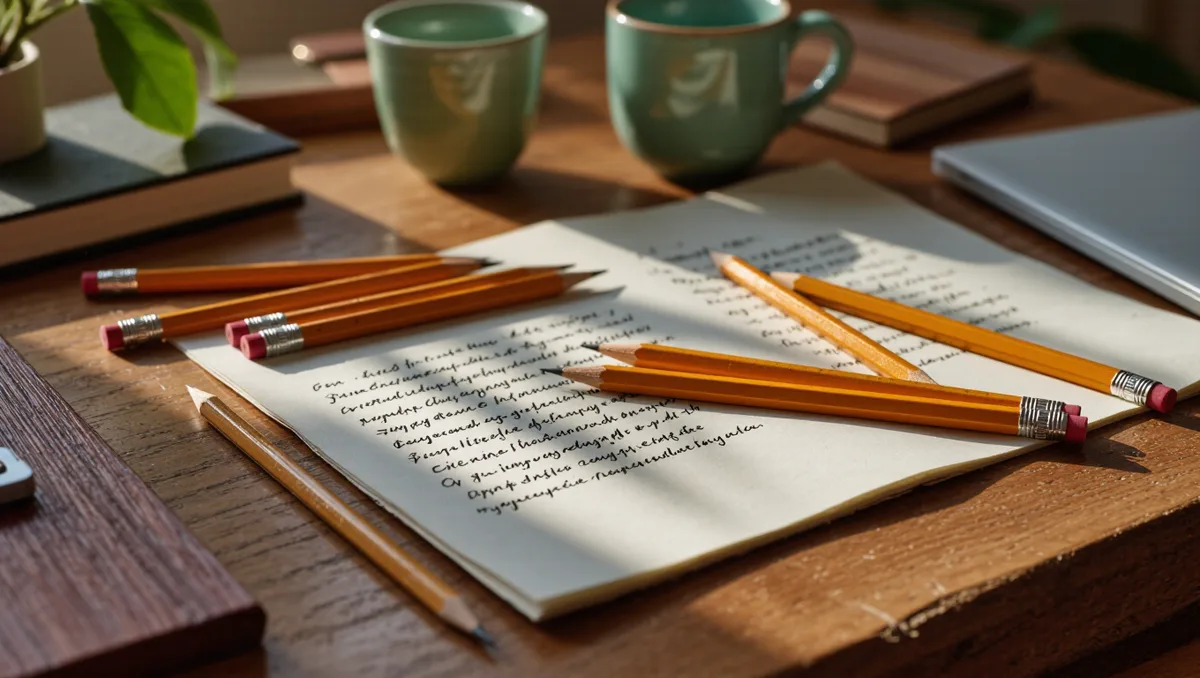
The diagnostic. Take any page of your draft and write down the word count of each sentence in order — a minute's work by hand. You now hold the page's rhythm as a number line. Read it against the page's intent: the confrontation should show a shortening trend into the turn; the aftermath should lengthen; the paragraph break before a revelation should visibly isolate a short sentence. Where the map flatlines through an emotional peak, the prose is amputating its own effect — and the fix is now arithmetic, not inspiration: break this sentence, join those two, cut that one to a fragment.
Where do fragments fit?
As accents, never wallpaper. The fragment — "Not again." "Two shots." — is the loudest unit in English prose because it breaks a grammatical expectation the reader holds unconsciously; loudness depreciates with repetition. The working budget most editors converge on is one or two fragments per scene, placed at turns. The same scarcity logic governs the paragraph break as a pacing device: white space is a pause the reader must obey, and the one-line paragraph is the fragment's structural big brother — the paragraph that gets a whole breath to itself. Both tools stop working the moment they stop being rare.
How do punctuation and clause order steer the same machine?
Three levers inside sentences of any length. The period placement lever: the strongest stress in a sentence falls near the end, so the word you want hit goes last — "He lied" outperforms "It was a lie" for reasons of position, not vocabulary. The subordinate-order lever: the main clause placed first moves, and placed last withholds — a sentence that makes the reader cross a dependent clause before the payload creates micro-suspense. And the connective lever: "and" chains momentum, "but" turns it, the semicolon braids two thoughts into one breath while the full stop severs them. Revising with these three in mind changes rhythm without changing a single content word.
What does deliberate violation achieve?
The advanced move: breaking the rule at the exact moment of maximum effect. The long sentence inside a fight produces slow motion — the style trick every thriller writer keeps in reserve for the blow that matters. The short sentence inside a reverie acts as an alarm clock. These violations work only against an established pattern, which is the deeper lesson of the passage map: you cannot meaningfully break a rhythm you have not built. Drafts that scatter fragments and one-line paragraphs randomly have loud pages and no dynamics, the typographic equivalent of shouting everything.
What does a worked revision look like?
One paragraph, before and after. Before: "She heard the door and turned and saw the coat and knew at once what it meant, because Marcus never left the coat, not ever, not even the night of the fire." One sentence, thirty words, evenly stressed — the revelation arrives at the same speed as the furniture. After: "She heard the door. She turned. The coat was there. Marcus never left the coat — not once, not even the night of the fire, when everything else went." The content is identical; the rhythm now does what the moment does: three short beats of recognition, then one held breath of history. That is the whole craft in one revision — no words added, only lengths re-decided.
How do you revise a whole manuscript for rhythm?
In dedicated passes, never mixed with content edits — rhythm revision requires reading at line speed while content judgment pulls the eye forward. The practical protocol: map one page per chapter (the page containing the chapter's turn), fix the flatlines, then read the fixed passages aloud; the ear catches what the number line misses. Writers who internalize the exercise report that the map becomes internal — they feel the sentence length as they choose it, which is the entire goal: pacing moved from accident to instrument.
Frequently asked questions
What is a good average sentence length?
For contemporary commercial prose, averages commonly land between 12 and 20 words — but the average is nearly meaningless alone, because two pages with the same average can flatline or sing. The distribution, not the mean, is the craft: the map, not the average, is what you revise.
Do long sentences always slow pacing?
They slow the reading but can heighten intensity — a sentence that refuses to end while tension builds is a documented thriller and literary technique. The slowdown is the point: immersion, dread, obsession. What long sentences cannot do is urgency, and confusing the two is the common drafting error.
Are sentence fragments acceptable in fiction?
Yes, as accents at turns — one or two per scene keeps them loud. Fragments as default style read as mannerism within pages, because the grammatical expectation they break is the same expectation every repetition dulls.
Does dialogue follow different rhythm rules?
The same physics with spoken grammar: interruptions shorten naturally, and speech's own fragments justify more of them than narration. But the map exercise works identically on dialogue pages, and exchanges that flatline in length read as two voices sharing one nervous system.