Point of view determines what the reader knows and when they know it, which means it determines suspense, irony, and the shape of every climax — a control problem before it is a voice problem. The strongest documented demonstration is structural: mystery fiction built its classic form on the Watson model, the first-person observer beside the smarter character, because that POV withholds as a feature. Choosing POV is choosing the novel's information contract, and most POV problems in drafts are contract violations wearing a costume.
What are the actual options?
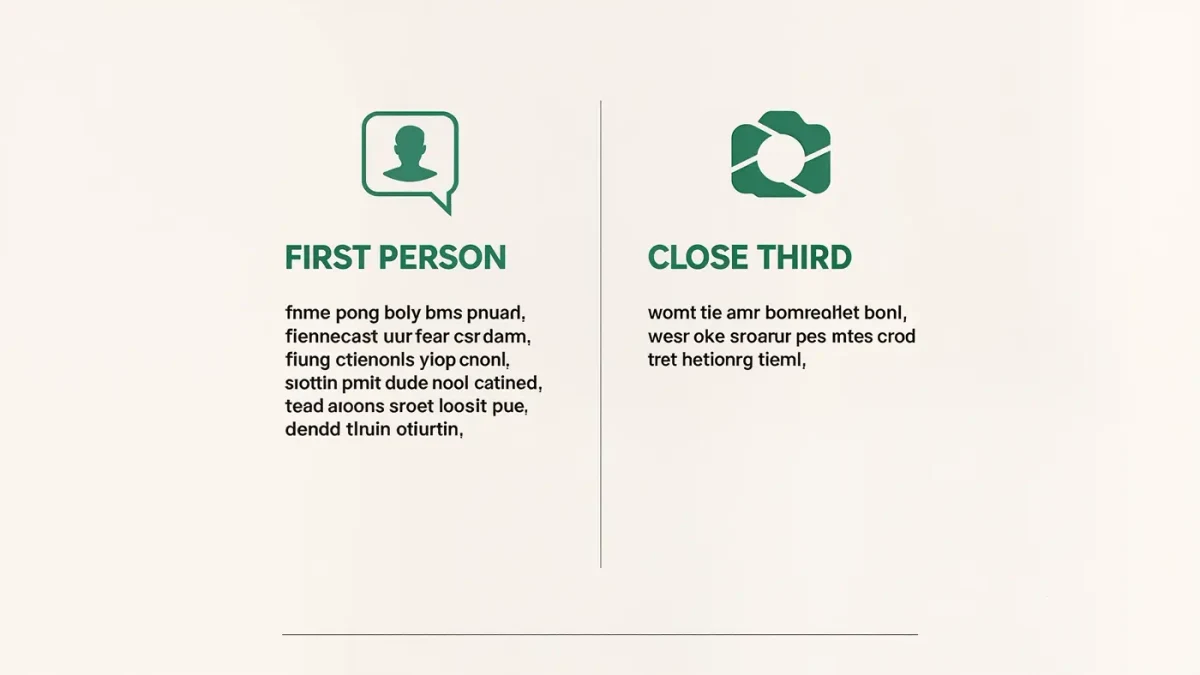
Four working modes cover most published fiction. First person — the narrator inside the story, voice-driven, exemplified by The Catcher in the Rye and by The Great Gatsby's observer-narrator Nick, who stands beside rather than inside the main action. Close third — the standard contemporary default: he or she, but locked inside one consciousness per scene. Omniscient — the knowing voice that moves between minds and comments, the mode of George Eliot's Middlemarch and the nineteenth-century tradition. Second person — you — rare and loud, with Jay McInerney's Bright Lights, Big City (1984) as the standard modern example. Epistolary and documentary frames (The Color Purple's letters, Dracula's assembled documents) function as first person distributed across documents.
What does each mode buy, and what does it cost?
| Mode | Buys | Costs |
|---|---|---|
| First person | Maximal voice, built-in unreliability | Narrator must be present for every scene; limited irony |
| Close third | Intimacy plus flexibility across characters | One head per scene, or the reader's trust erodes |
| Omniscient | Scope, judgment, movement across time and minds | Demands authoritative prose; distance from feeling |
| Second person | Immediacy, accusation, estrangement | Exhausting over length; reads as device |
| Epistolary | Documents carry plot; intimacy by artifact | Plausibility load — why is this being written? |
Why is close third the default in contemporary fiction?
Because it is the best value trade. First person's intimacy comes yoked to its narrator's presence and prose ability; omniscience's scope costs closeness. Close third delivers interiority — thought rendered without quotation — while letting the writer change viewpoint characters between chapters, which is how modern novels get scope without a god-voice. Editors' and agents' consistent advice, visible across decades of craft columns, is not that third is superior but that it forgives more: a first-person novel where the voice is weak has nothing behind it, while a weak close third can still carry story until the prose matures.
What is head-hopping, and why do editors keep flagging it?
It is the unannounced move between consciousnesses inside a single scene — we are in her suspicion, then a paragraph later in his guilt, with no break. The cost is not rule-breaking; it is that the reader loses the contract. When any head is available, none is trusted, and the scene's information loses its carrier. The repairs are mechanical: break the scene at the switch, give each consciousness its own scene or chapter, or pull back to a neutral camera that reports only observable behavior. Omniscient narration is not head-hopping — the difference is that omniscience establishes its knowing voice up front and hops deliberately, with the narrator's control as the mechanism, rather than drifting mid-scene.
How do you test a POV choice before writing 80,000 words?
Three tests, run on one drafted chapter. The climax test: write the last scene in the chosen POV and check whether the reader holds the information the scene needs — mysteries fail here constantly, and the fix is either a Watson or a duplicitous first person. The voice test: for first person, read the narrator's non-plot monologue — a page about anything — and check whether the voice is a reason to keep reading; if not, close third. The distance test: mark each place the chapter needed to pull closer or push farther; POV modes vary in how far their lens travels, and a story that keeps needing telescope and microscope in the same scene is asking for omniscience or a restructure.
When should the choice change mid-project?
More often than writers admit, and earlier than they try it. Drafts that will not come alive in close third sometimes wake immediately in first — the classic workshop rescue — and the reverse happens when a first-person voice cannot get to the scenes it needs. The cost of switching rises with draft length, so the right moment is the first structural stall, not the fourth. The pragmatic method: redraft one middle chapter in the other mode and read both cold a week apart. What the test measures is not preference but access — which version of the lens actually reaches the material.
What does distance do inside a single mode?
This is the control writers overlook: every POV mode contains a zoom. Close third can render raw thought (he thought: no), reported thought (he wondered whether), and external observation (he looked at the door a long time) — three distances, one mode, selected sentence by sentence. Mastery of POV is mostly mastery of this zoom: close in for the turn, pull back for the aftermath. The novelists readers describe as controlled are the ones whose distance moves are deliberate, and revision passes for POV should read for exactly one thing — where the camera sat when the sentence was written, and whether that is where it should have sat.
The mistakes here are cheap to prevent and expensive to fix. A POV chosen in an afternoon, tested against the ending and the voice, holds a book together sentence by sentence; a POV inherited from whatever the last novel read was doing has to be repaired chapter by chapter, in draft after draft, by a writer who will eventually discover they were solving the wrong problem the whole time.
Frequently asked questions
Can a novel use more than one POV?
Yes — multiple close third and alternating first person are standard structures. The contract just needs to be legible: one viewpoint per scene, a clear pattern (chapter breaks or named headers), and each viewpoint earning its place by carrying information no other head can.
Is present or past tense part of POV?
Related but separate: tense is the time contract, POV the knowledge contract. Present tense adds immediacy and suits close modes; past suits omniscience and retrospection. The combination — mode, distance, tense — is the full camera, and changing one changes the others' effect.
How do I choose POV for a mystery?
Decide what the reader must not know, then pick the head that cannot know it. The Watson observer withholds by position; the guilty first person withholds by intent; close third on the detective invites the reader to out-think the book. The choice is the puzzle's hiding place.
What if my beta readers say the POV feels distant?
Check the zoom before the mode. Most 'distant' drafts are close third written at observation distance — no rendered thought for pages. Drop into thought for the turning sentences, and the mode usually fixes itself without restructuring.