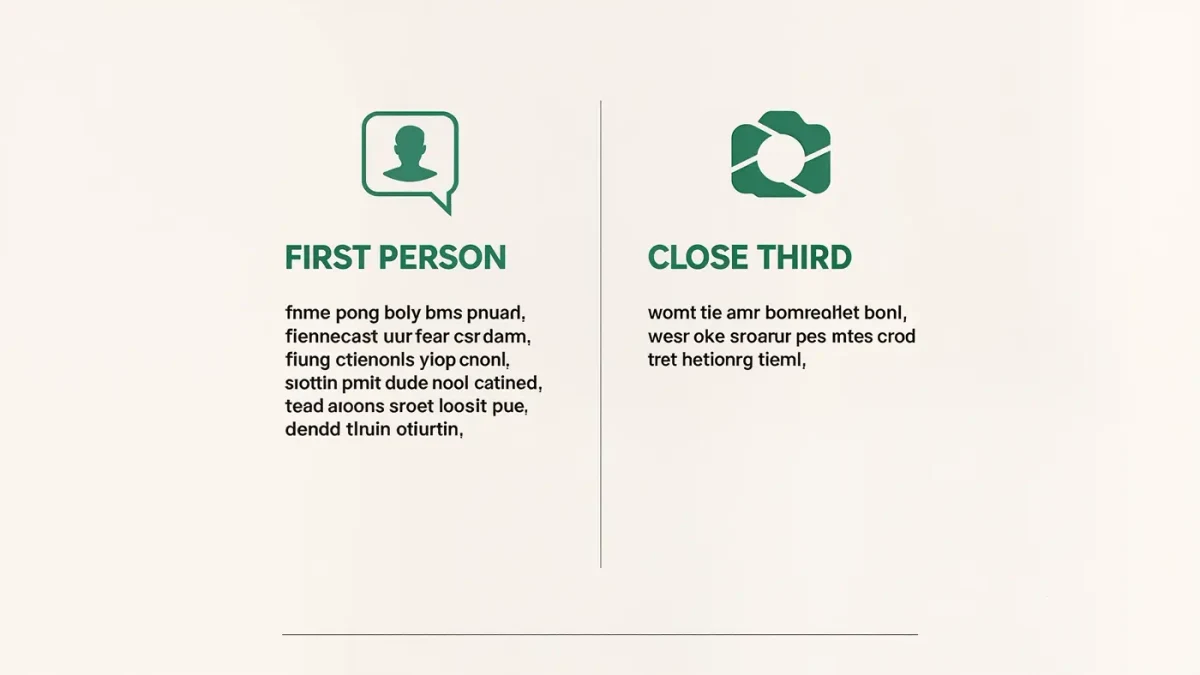
The honest way to choose between first person and close third is to draft one real scene both ways and read the two versions cold a week apart — the workshop exercise, run on a 600-word scene, reliably surfaces what no pros-and-cons table captures. The two modes differ in three mechanical places: who owns the sentences, what the narrator is allowed to know, and how distance moves. Below, a single scene rendered both ways, then the analysis a writer can repeat at home.
The scene, in outline: a woman returns a borrowed dog to her former neighbor and sees the apartment stripped for moving. Drafted in first person, the paragraph runs: "The hallway smelled the same, which offended me. He'd packed the dog's bowls first — of course he had; he always did the easy things first." Drafted in close third: "The hallway smelled the same, which offended her. He'd packed the dog's bowls first — of course he had; he always did the easy things first."
What changed between the two sentences?
Almost nothing on the page — a pronoun — and everything in the contract. In the first-person version, "offended me" is testimony: a person who survived this story is telling it, and the reader may weigh her as a witness with an agenda. In close third, the same phrase is free indirect discourse — the narrator's sentences bending into the character's diction without quotation — the technique with a documented pedigree running from Austen through Flaubert to the contemporary default. The craft difference is ownership: first person's judgments belong to a character the reader is watching; close third's belong to a lens the reader is borrowing.
What does first person buy in the full scene?
Voice as evidence. The first-person version can carry a retrospective frame the close third cannot: the narrator may hint she knows how this ends ("The last time, as it turned out"), may misremember in ways the plot later exposes, and may interpret the neighbor's packing choices with a bitterness that characterizes her rather than him. First person makes the narrator a character with a stake in the telling. The documented costs arrive in the same package: the narrator must plausibly witness every plot-relevant event, the prose is hostage to one voice's charm for a whole book, and description becomes a personality test — every room must be filtered through diction the character owns.
What does close third buy?
Zoom. The close-third version can move its lens sentence by sentence: exterior observation ("she stood in the doorway"), rendered thought, and free indirect judgment can alternate inside one paragraph, where first person is locked at the narrator's fixed distance from herself. Close third also keeps the reader's irony available — we can see the neighbor's packing as neutral or kind while she reads it as spite — a double vision first person must engineer through unreliability instead. And the mode scales across a cast: chapter breaks can hand the lens to another character without breaking the book's physics, the structural freedom behind most multi-viewpoint novels.
How do you run the experiment on your own scene?
- Pick a scene with one character, one want, and one charged object — the dog, the bowls, the packed boxes.
- Draft it in your habitual mode at whatever speed is normal.
- Convert mechanically first: swap pronouns, adjust possessives, keep every judgment and bit of diction.
- Then revise each version for its mode's strengths — add a retrospective hint to the first, a lens move to the third.
- Date both, shelve them for a week, and read cold in one sitting, recording where each version pulled or dragged.
How do you read the results?
For the diagnostic signals. If the first-person version's voice energized pages the third-person version made dutiful, the book wants a narrator, and voice work becomes the project. If the third-person version freed scenes the first-person version strained to reach — the neighbor's afternoon, the moving truck, anything the narrator couldn't witness — the book wants the lens, and structure work becomes the project. Writers with a strong comic or distinctive voice consistently hear the advantage of first; writers with intricate casts or dramatic-irony plots consistently hear the third's room. The tie, which happens, usually breaks toward close third for a debut because the mode forgives an imperfect voice.
| Question about your book | Answer pointing first | Answer pointing close third |
|---|---|---|
| Is the telling itself characterized? | Yes — the narrator argues, confesses, spins | No — the story argues |
| Must scenes occur off-stage? | Few; narrator present throughout | Many; cast disperses |
| Irony source | Narrator's blind spots | Reader's overview |
| Voice durability at 80k words | Tested and certain | Unproven |
What about the reader's trust?
The modes earn it differently, and the difference compounds across a book. First person deposits trust immediately — a voice is speaking, and voices hold attention the way strangers' confessions do — then spends it on every interpretation the narrator makes; the reader audits. Close third starts leaner, assembling trust from accuracy of perception, and gains steadily as the lens proves it will notice what matters. The practical consequence for revision: first-person drafts fail at the interpretation level (the narrator over-explains motives the reader already discounted), and close-third drafts fail at the attention level (the lens notices the wrong things). The two modes need different proofreading instincts — audit the opinions in one, audit the observations in the other.
Can you convert a finished draft between modes?
Yes, and the documented rescue stories — drafts that woke when shifted into first person — are common enough that conversion is a legitimate revision tool. But conversion is a rewrite, not a search-and-replace: pronouns are the trivial 10 percent, and the remaining 90 is re-owning every sentence. The mechanical pass converts; a full voice pass makes it live. Budget accordingly: a converted draft costs nearly a new draft, which is why the experiment belongs at the outline stage, run on the one scene that best represents the book.
Frequently asked questions
What is free indirect discourse?
The close-third technique of rendering a character's thought and judgment in the narration's own grammar, without quotes or italics — "of course he had; he always did the easy things first." Its documented lineage runs from Austen through Flaubert into the modern default.
Can a book switch modes midway?
Rarely to good effect — the switch reads as an event or a mistake. Alternating first-person narrators, or close third with rotating viewpoint chapters, achieves the mix without breaking the contract.
Which mode do agents see too much of?
Craft columns converge on two submissions patterns: shaky-voice first person and head-hopping third. Both are fixable — the first by the experiment above, the second by one-head-per-scene discipline.
Does present tense change the comparison?
It sharpens it: present-tense first person maximizes immediacy and sacrifices retrospection entirely — the narrator cannot know the ending. Present close third keeps a sliver of narrative hindsight. Tense is the time contract layered over the knowledge contract.